Report · Local Post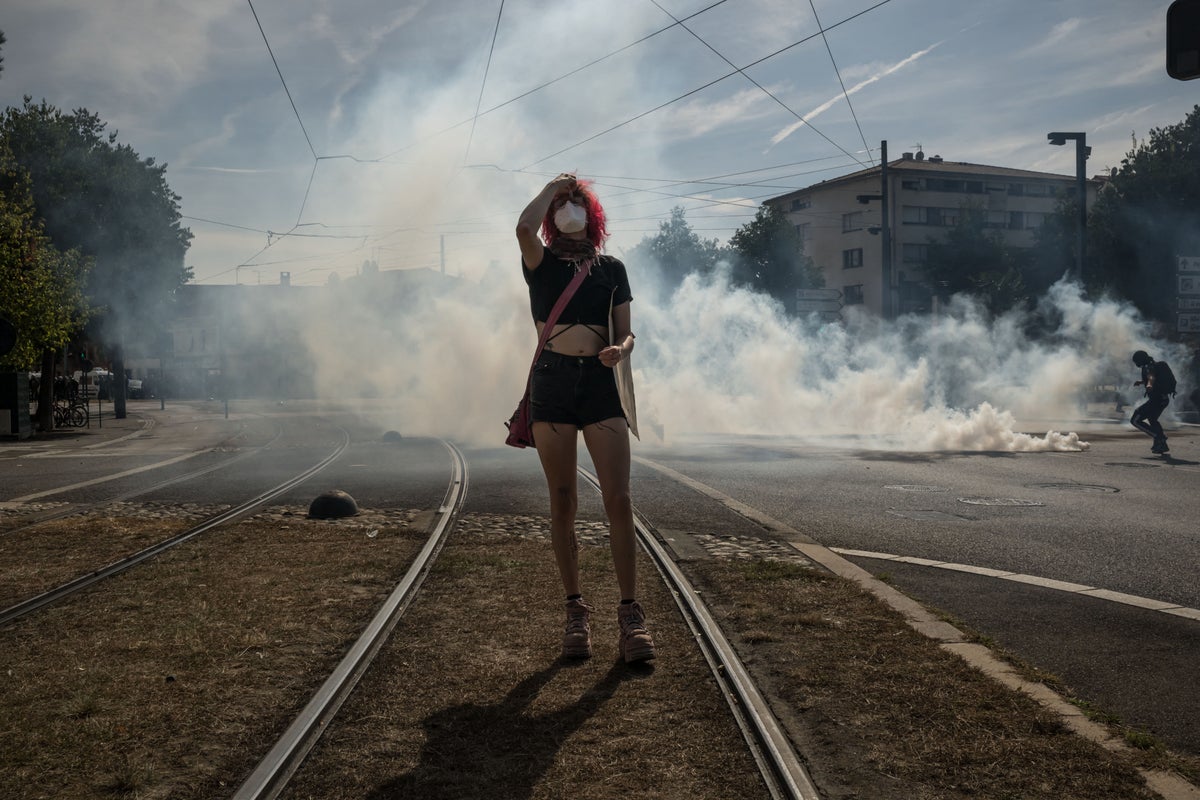
T hese past weeks, traditional learning across French cities has been replaced by student protests . Beyond barricades of overflowing bins, sharp-stinging tear gas, and fires drifting past schools, the daily routine for millions of lycéens has collapsed. What started as local outcry over missing staff and poor facilities in mid-September is now a nationwide youth protest.
Students across France aren't taking to the streets to “skip class” – they are protesting (the so-called “gilets jeunes” protests) because there is hardly any class to attend. Outrage over a failing system closed around 500 schools on 5 October – and led to more than 5,000 detentions nationwide. As blockades and police clashes escalate, students counter popular stereotypes.
They aren't just skipping class, but are overwhelmed by burnout, underfunding, and anxiety over their futures. We’re final-year students at a school in Toulouse, getting ready to head to university. This is the sort of thing our classmates and peers at other schools say: “During the summer it’s 36 to 40 degrees inside the classroom and we have no fans or air conditioning,” explains Aniket Sudambi, a 17-year-old student at a public lycée in Toulouse.
“Our classes are filled with around 40 students... It gets really hot and hard for us to concentrate for the classes that last 2 to 3 hours.” As summer heatwaves have become increasingly severe across France this year , outdated school infrastructure simply cannot manage these temperatures, causing physical discomfort due to lack of school funding. The buildings are simply too old.
A few weeks ago, there was a fire in a school in Toulouse due to a short circuit. Adding to this, teacher shortages leave classrooms unsupervised for months at a time. Those who are there are underpaid and under-resourced.
For students sitting at these desks, the daily schedule leaves them completely drained due to long hours. “We work around 38-40 hours a week due to our heavy school schedule of 8am to 6pm every day,” Sudambi says. “This prevents us from taking care of ourselves in a mental and social way.
Especially for students who live an hour away or rely on public transport – they leave their house at 7am and don’t reach home sometimes until 8pm. It makes their week really, hectic.” These hours include campus time, but not homework, additional studies or university preparation, which contributes to reducing the sleep crucial to the students’ need to function still further. Adding to this physical and mental exhaustion is the ordeal of Parcoursup, France’s higher education admissions platform – which is a little like the UK’s Ucas, but with a waiting list where applicants see their exact daily rank and position shift live as higher-ranked students decline offers.
It was introduced in France in January 2018 under Emmanuel Macron. Therefore going into your final exams, you can know, for instance, that you’re 6000th in line for a single space at on a university course. The process has turned university entry into an extremely stressful process, placing high pressure on teenagers who already struggle under broken learning conditions.
“Parcoursup has made the process of getting into universities unrealistically competitive and selective,” Sudambi points out. “Engineering courses that aren’t even in top-rated universities in France still require minimums of 15 or 16 out of 20 in specialty subjects. That is a lot and very rare to achieve in the French Baccalaureate, especially with these school conditions.” Uniting over these shared struggles, students in Toulouse and across France are challenging the system even as social media highlights escalating violence at protests .
However, Sudambi clarifies “the violent parts of the protests aren’t necessarily all students of the lycée, but often the students who either were expelled or come from poorer neighbourhoods who feel particularly oppressed by the state, they express their anger towards the police through violence, burning schools, dustbins and throwing firecrackers”. Severe pressure building inside the classrooms is why this anger boils over into main city streets. The students are furious because they feel completely trapped in a system that demands absolute perfection while offering them failing systems.
On top of physical and mental stress, when voicing concerns, students feel brushed aside by government officials and dismissed by the public as lazy teenagers who “just want to skip class”. When overwhelming academic pressure and institutional neglect are met with heavy police responses rather than solutions, students’ frustration turns into rage, a collective anger from feeling ignored, pushed to their limit, and out of control. Ultimately, the mass student blockades and street protests sweeping across France are not just teenage rebellion, but a direct response to deep-rooted structural issues.
Years of decaying infrastructure, shortage of qualified teachers, and demanding schedules have pushed students to their breaking point. The rising tension between a generation striving to acquire a basic right to education and a nation that responds with heavy security measures has transformed secondary schools into chaos. French lycéens are engaging in mass protests to reclaim their right to education, protect their well-being, and secure a respectable future.
Trapped in 40-hour weeks, crumbling spaces, and the pressure of Parcoursup, students aren't rejecting education – they're demanding conditions that make learning possible. The mass protests are a demonstration of a youth generation that recognises their future is on the line, choosing to fight for a better today rather than letting tomorrow be compromised.
Source: The Independent